
Something I focus on in AI training sessions is getting teams to look beyond efficiency to what AI now makes possible. The things you’ve always wanted to do but never had the time, resources, or capabilities for. Take marketing planning. Most of what we deliver is fairly standard: research summaries, campaign plans, user journeys, creative briefs, etc. And most of it ends up as a document or deck of some kind. There’s now an opportunity to rethink that format, both to capture the information and to actually use it.
AI lets non-technical folks build different kinds of deliverables (OpenAI’s new Sites feature turns documents into interactive apps). So, at the start of a project, it’s worth exploring what form this information or recommendation could best take for the team that has to act on it. For example, a forecast can become a scenario planner, a research report can become a knowledge base, a media plan can become a budget allocator where you shift spend and see the trade-offs.
Here are a few prompts for you to noodle on the next time you build a deck: Would it be more useful if it was…
Queryable: where people could ask your document questions?
Interactive: where people could change inputs and see effects in real time?
Collaborative: where several people could add to and edit it in one place?
Navigable: where people could jump to what they care about instead of reading linearly?
Self-updating: where the resource updates itself over time?
Below is an example to get you thinking about how a static, standard deliverable can become more useful with AI, focusing on customer personas.
You can download the instruction file here.
If you’d like to explore more about how marketers are using AI, register for my next AI Share & Tell on Thursday, June 25 at 12:00pm EST. It’s free: part training session, part roundtable. I ran one earlier this year and it was a lot of fun. I’ll share a few new lessons and tools, and we’ll do a quick round of practical AI uses people have found.
AI Reshaping Search
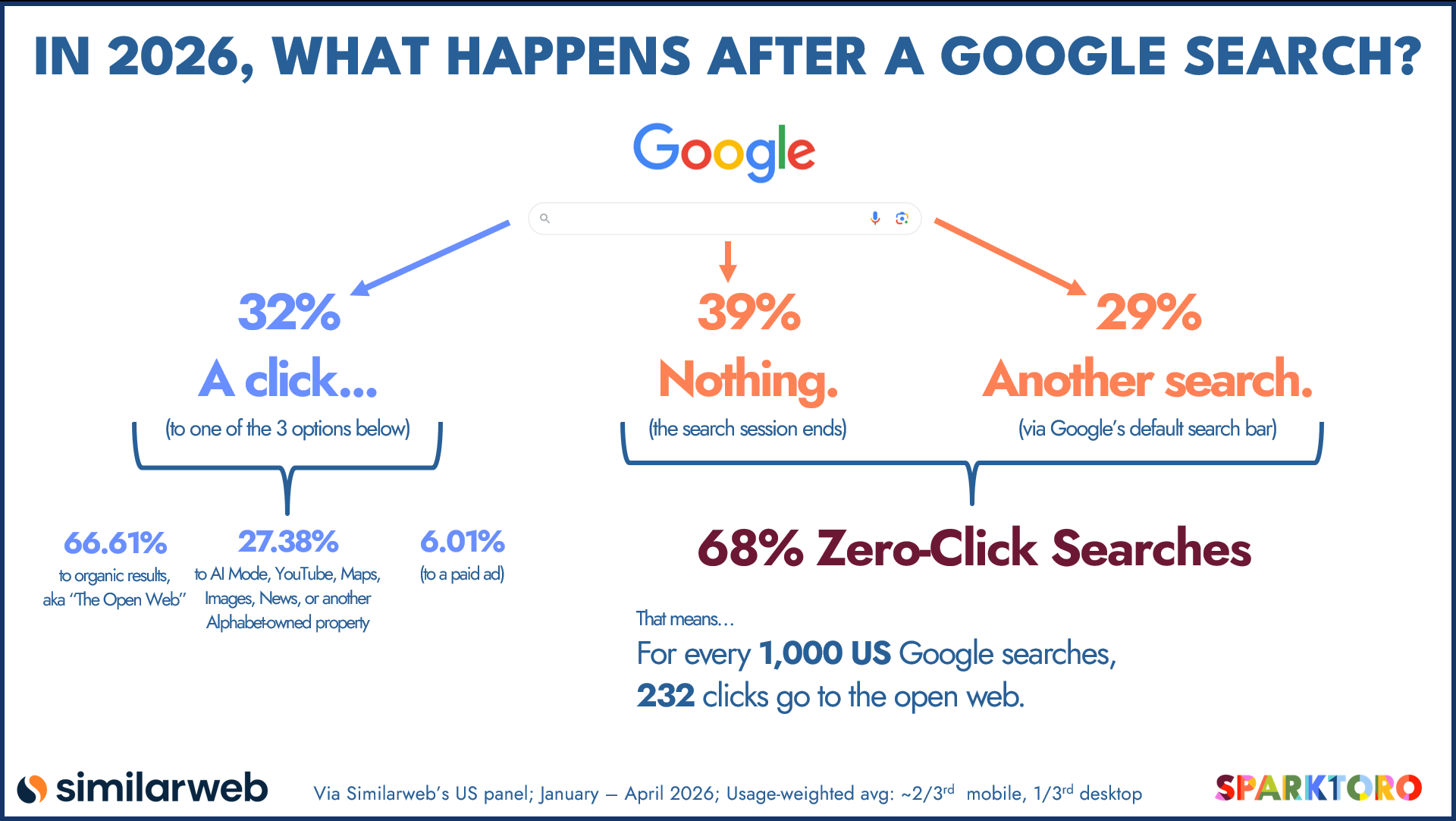
AI keeps reshaping search. New research shows 68% of Google searches now end without a click, a figure that’s been climbing in large part due to AI Overviews: the answers Google synthesizes at the top of the page, pulled from the sites it used to send traffic to. In a controlled experiment, zero-click searches jumped from 54% to 72% on queries where an AI Overview appeared, cutting organic clicks 38% on those.
Publishers aren’t happy about their content being summarized with no traffic in return. Prompted by a UK regulator, Google is now testing a control that lets them opt out of AI search features while keeping their regular listings. All of this makes things harder for brands trying to reach those qualified, lower-funnel searchers they’ve been focusing on. Media planners need to be even sharper: better at knowing where to reach their audiences, and where AI engines are pulling their references from.
Fresh Research
Gartner CMO Survey: AI Marketing Automation (Gartner): Gartner’s survey of CMOs finds that marketing leaders expect AI-driven automation of marketing work to more than double, from 16% in 2026 to 36% by 2028.
Marketing Leadership in the Age of AI (Marketing Week): New research finds that just 5% of marketers expect AI to create new roles or opportunities, while 19% expect to cut headcount as a result of AI automation.
Global Workplace Survey 2026 (Gensler): Gensler’s survey of more than 16,400 office workers finds that the 30% who qualify as “AI power users” spend less time working alone and more time learning and socializing than their peers, challenging the assumption that more AI means more isolation.
Cool Beans
Pinterest Summer Trend Report: What are people searching for on Pinterest these days? Pretzel Jello Salad, French Wispy Bangs, and Dad Runners (the shoe, not the dad).

AI Smart Toilets: Japanese toilet maker Toto’s stock increased by 18% after it announced it was increasing its investment in AI. Perhaps trying to compete with this smart toilet that comes with an app.
Gudtrip: Might I interest you in a vape pen that connects to a mobile app that uses blockchain and AI to reward users with bitcoin?