Last night I spent an hour on ChatGPT figuring how to upgrade the Wi-Fi in my house. I started with a vague idea of my options and ended up buying five products to install. The experience differed from a traditional online search because I could:
Access general guidance and answers framed around the problem I was trying to solve, with technical details dumbed down (a few levels) so I could understand them.
Review detailed comparison of products across brands and retailers, identified and scored based on my specific needs.
Confirm my product choices sourced from reviews, and the compatibility of the products based on product manuals.
It was clunky in spots. I had to remind ChatGPT of context to evaluate options based on my current setup. When it came to the final steps of purchasing, some of the retailer links were broken or out of stock.
But overall, the experience felt informative, personalized and - with the evergreen caveat that AI hallucinates – pretty trustworthy. I’ll report back on whether it works.
Regardless, shopping is changing with AI. But how?
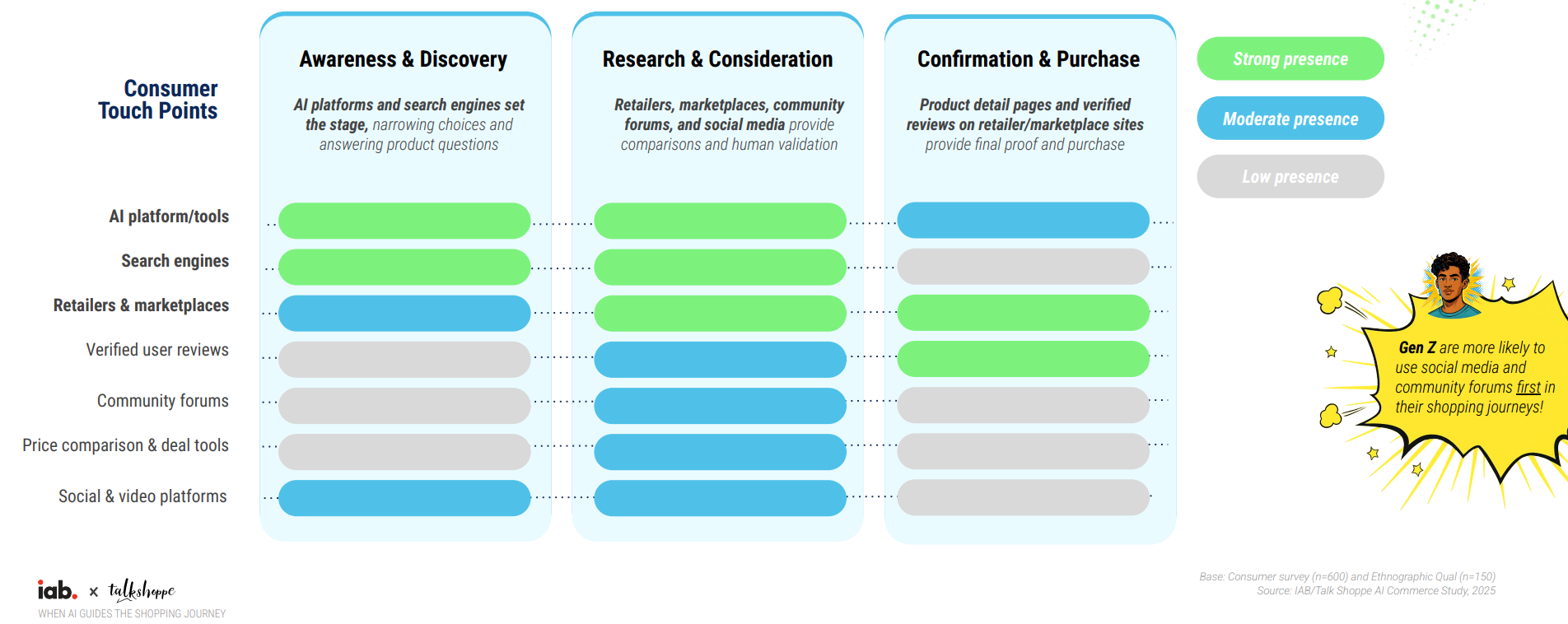
The IAB released a great study on the role AI is playing in the shopping journey. Its findings generally align with my experience. AI is being used most effectively mid-funnel, where decision-making complexity is highest. However, for many, AI isn’t removing steps from the process—it’s adding them, as people validate AI-generated recommendations elsewhere.
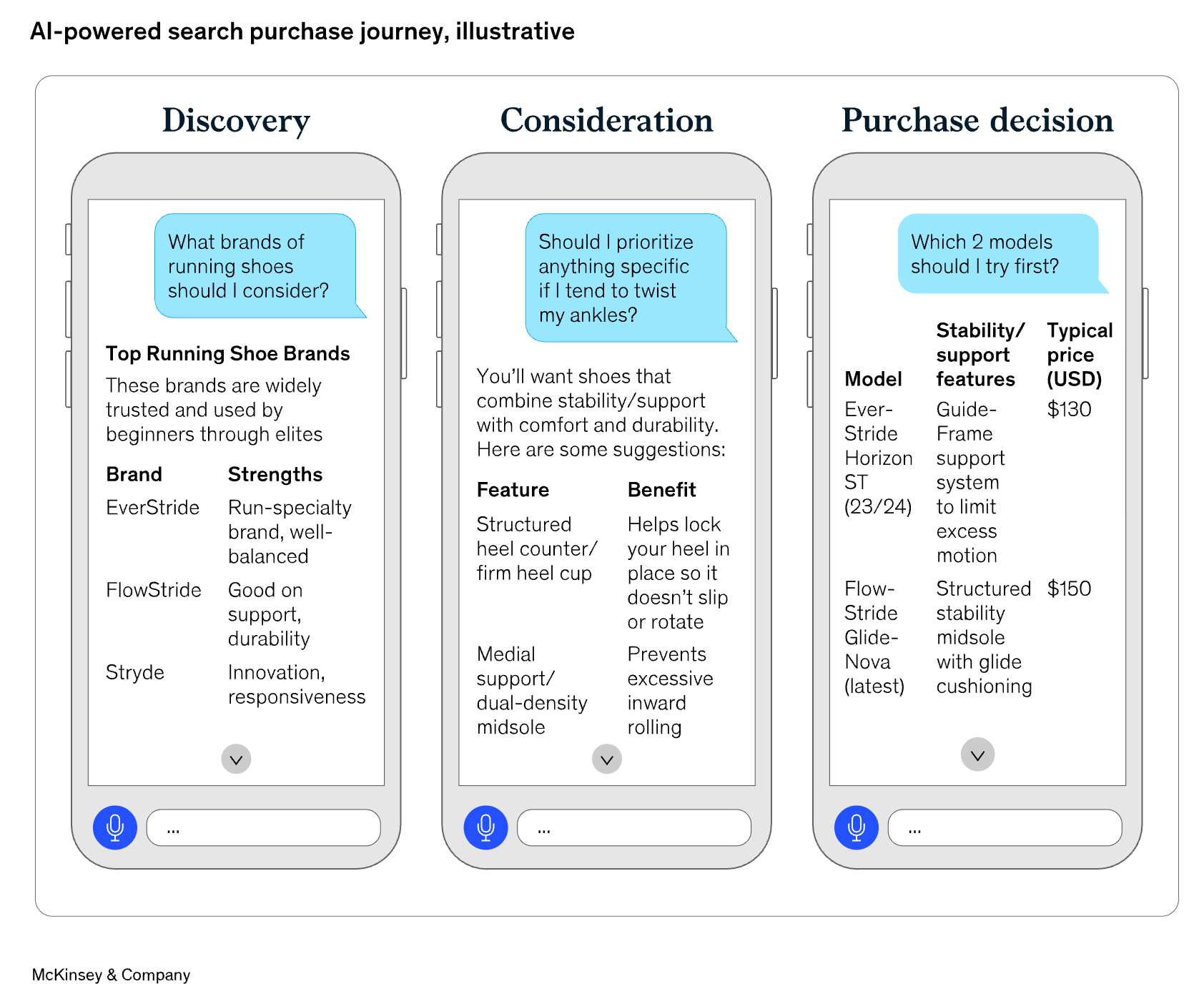
McKinsey released a similar study, highlighting the different ways that customers use AI-powered search for different stages of the journey.
How can AI help complete this last step? ChatGPT recently introduced Shopping Research, a tool designed to help people find and compare products—presumably with ads coming soon. Further down the funnel, major platforms are rolling out agentic solutions that can complete purchases. Google, for example, has launched a service that can call stores or check out on retailer websites automatically when a price drops.
However, retailers are not pleased. Amazon has filed a lawsuit against Perplexity for using its AI agents to search products and complete purchases on its site. They’re concerned about losing control of the shopping interface, where much of their advertising revenue comes from. Bain has released a new report outlining the different paths retailers can take in response, including building their own AI agents.

AI & ADVERTISING
How is AI impacting search advertising? McKinsey estimates that 20-50% of customer traffic from traditional search is at risk of shifting to AI-driven search. That’s a wide range – c’mon, seriously, McKinsey - but the takeaway is clear: the shift is significant. Advertisers should focus on understanding where AI chatbots source their information to ensure strong representation in AI search results. Currently, only 16% of brands systematically track AI search performance. A recent SEMrush study found clear differences among platforms: ChatGPT most often cites Reddit and Wikipedia, while Google’s AI Mode favors Google-owned domains. The landscape is evolving quickly. Here’s a useful backgrounder from Ofcom on GenAI search, outlining the main types.

AI RESEARCH & REPORTS
2025 Edelman Trust Barometer: A useful snapshot of people’s current attitude toward AI. In general, trust is the biggest barrier to adoption (more than access, motivation, ability). At the workplace, enthusiasm for AI grows if workers receive training or feel sure that AI will be used for productivity, not job elimination.
Parent & Teen AI Use (NORC): Survey indicates that unlike the early days of social media, AI adoption isn’t dramatically skewed toward younger generations. In fact, both groups use it in similar ways.
Canadian Business & AI Use (KPMG): Survey of executives found that 93% of organizations are using AI in some way, up from 61% last year but only 2% are seeing positive ROI. Most are still in pilot phase.
AI Eats The World (Benedict Evans): Always a must-read from Benedict Evans, which his bi-annual big picture tech perspective – this time placing AI in a historical context to try to understand what comes next.
The Impact of Visual Generative AI on Advertising Effectiveness: If you’re looking for proof that humans create more effective advertising than GenAI, maybe give this one a pass.
COOL BEANS
Corners of the Internet Database: Curated list of links to sites that are keeping the web weird. Like The Fish Doorbell - a livestream showing fish swimming through Utrecht, where viewers can watch a lock operator open a gate to let them pass.
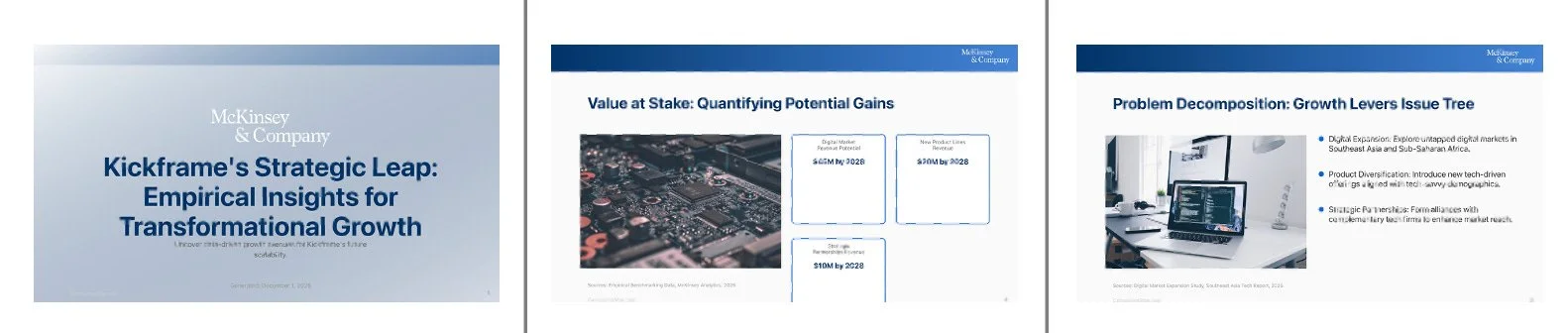
Consulting Slop: Provide a company name, business problem, and consultancy brand and have a presentation deck created for you instantly. I’ve seen worse.