
Happy 2026! I hope you had a fantastic break and that your year is off to a great start.
This year, I’ll be focusing even more on the practical application of AI in marketing—both in my work with teams, and in what I share through this newsletter. In my training sessions, I’ve found that people are tired of the AI hype and are much more interested in the tangible ways AI can help in their day-to-day work. Some of the best moments in training sessions come when people share their own discoveries—simple hacks, prompts, or clever ways they’ve made AI part of their workflows.
To build on that, I’m hosting an AI + Marketing Show & Tell on January 22 at 12:00pm EST. It’ll be part training session, part roundtable. I’ll share a few lessons from the past year, and if enough people join and volunteer, we’ll do a quick round of sharing practical AI uses—big or small—that make marketing work even 1% easier or more enjoyable.
If you’re interested in joining, sign up here and I’ll send you the details.
AI Use in Marketing
Research on marketers’ use of AI continues to show consistent findings: everyone recognizes its importance, but the majority remain in a quasi-experimentation phase. More recent research reveals some useful nuance around adoption patterns and tips for success. Key trends and lessons emerging about how marketing departments are using AGI include:
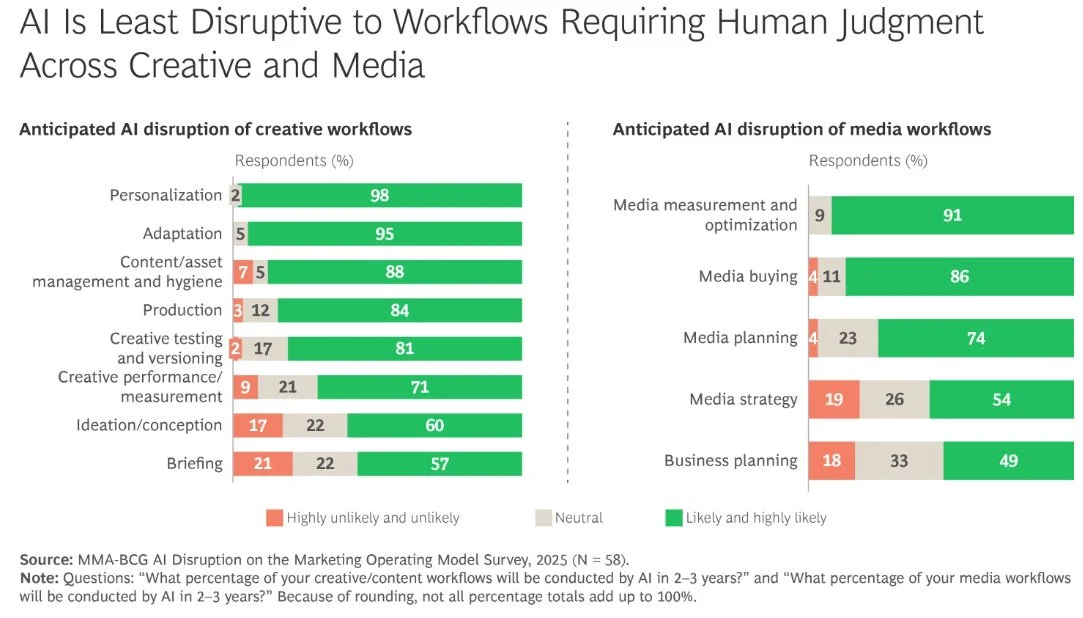
AI is considered less likely to disrupt marketing workflows that require human judgment (briefing and ideation) compared with workflows that are more production or automation focused (personalization and adaptation).
86% of CMOs believe that creative agencies are not yet using AI at scale, and 60% of those CMOs believe agencies need to provide staff with AI training and upskilling.
CMOs reporting more positive AI impact tend to create 9 - 12 month roadmaps that address tools, governance, talent, measurement, and training. Among these CMOs, 75% are investing in GenAI upskilling across all levels.
Senior marketing and CX executives see the biggest areas of AI impact over the past year as increased productivity and greater content and idea output. Additionally, 47% report revenue growth as a result of marketing more effectively.
Marketing teams underestimate the time and costs associated with incorporating AI into their work. While developing assets more quickly is a benefit, that does nothing for the time required for reviewing assets and approvals from clients: “The real cost isn’t generating assets, it’s generating your assets…a single prompt can give you 200 like, pretty good options. But someone has to sift through and judge and refine. That decision work used to be invisible; now it is the job.”
Beyond using AI for efficiency in producing assets, marketers and creative agencies are also applying generative AI to develop creative concepts that would otherwise be too costly to produce at an acceptable standard—for example, Jeep’s recent campaign featuring AI-generated wild animals speaking in the ad.

Looking at the role AI plays in the customer journey, surprisingly (to me), younger consumers are fairly positive (48%) toward agentic AI—specifically, a brand using a virtual shopping assistant that browses sales and adds items to their cart based on styles and past purchases.
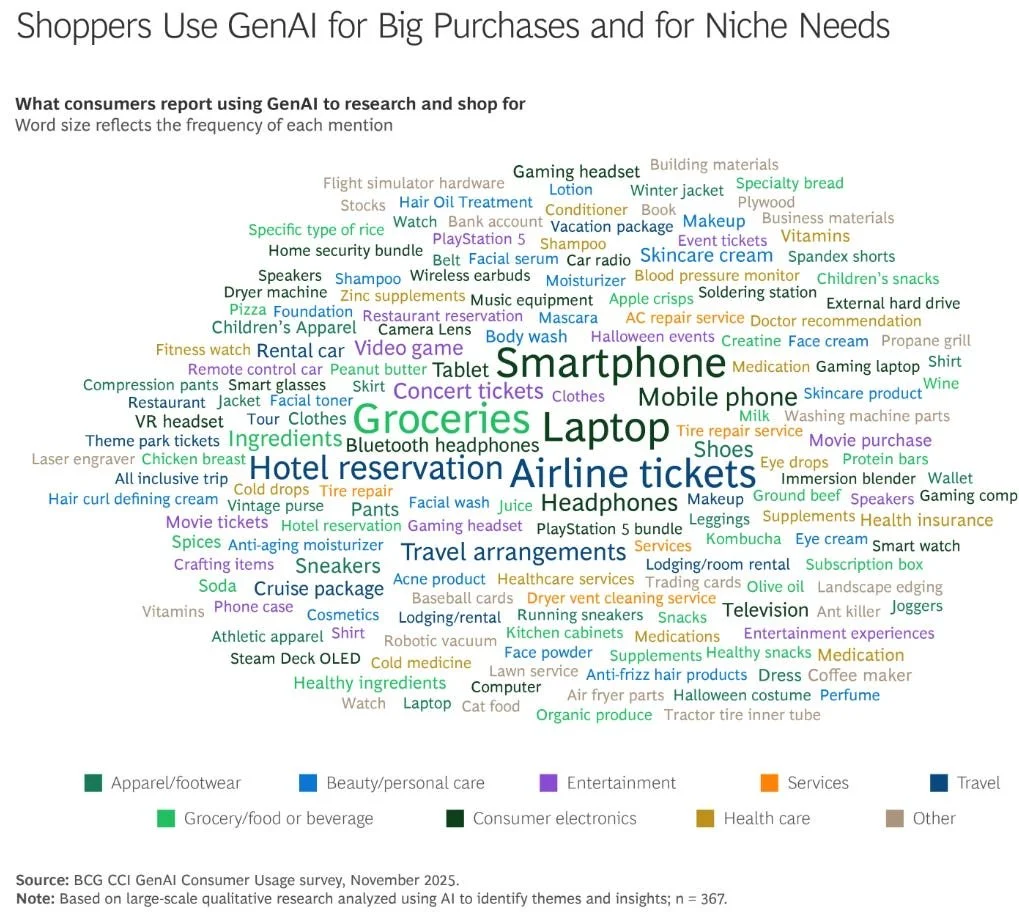
Shopping-related GenAI use grew by 35% between February 2025 and November 2025. It is used for a wide range of purchases, but activity focuses on higher-consideration decisions, including travel planning and detailed technical comparisons such as laptops.
Fresh Research & Decks
AI X Commerce in 2025 (Juozas Kaziukėnas): A super-useful and up-to-date primer on the impact of AI on commerce. Great perspective on how the customer journey and retail media is changing.
Digital Twins as Funhouse Mirrors: An academic study finds that much vaunted AI-generated digital twins used for research are not reliable substitutes for real human responses. Edward Cotton shares a useful marketer’s perspective on LinkedIn, with a lively debate in the comments (many coming from companies selling AI-generated digital twins).
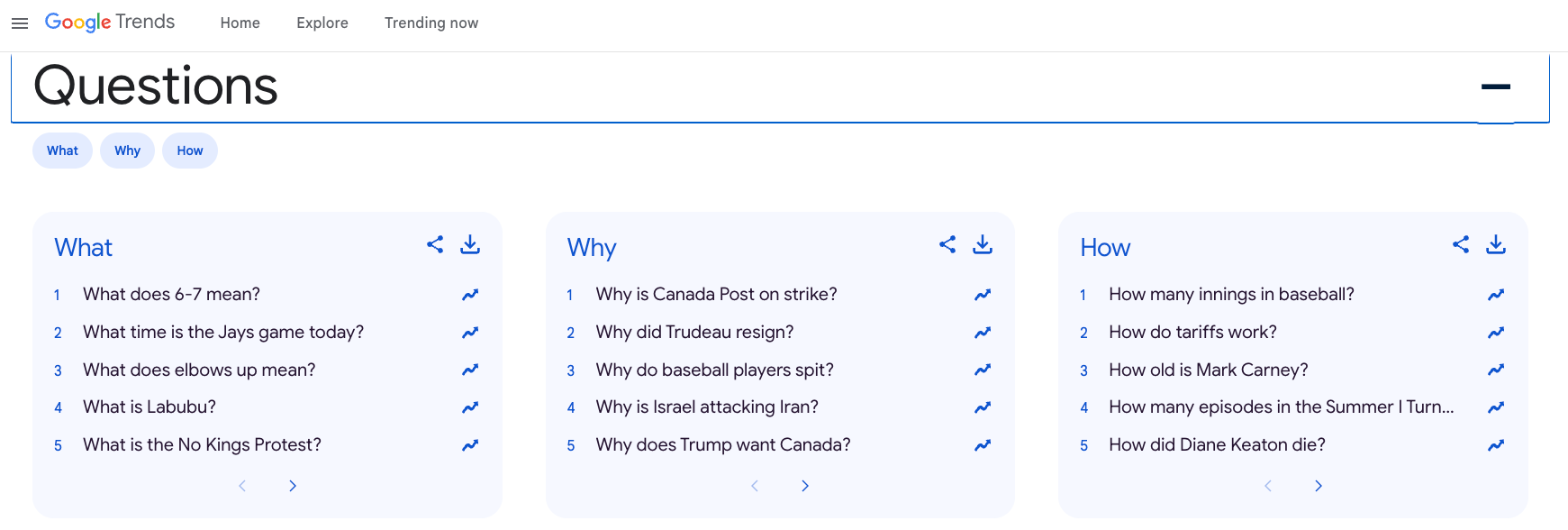
Teens, Social Media, and AI Chatbots in 2025 (Pew): Nearly two-thirds of U.S. teens use AI chatbots like ChatGPT, with about one-third using them daily. About one in five teens say they are online “almost constantly.” 3 of those teens live in my house.Year in Search 2025 (Google Search): Always a fun time capsule of the top searches by country. In Canada, where the Blue Jays had an amazing World Series run (I still don’t want to talk about Game 7), trending searches included: What time is the Jays game today? How many innings in baseball? And (a question asked repeatedly in my house): Why do baseball players spit?
Cool Beans
Promptist: If you’re looking to level-up your prompting, this tool is worth trying. It shows how a rough prompt can be expanded and improved with more detail and structure. It can also give you ideas for breaking tasks into more focused, smaller prompts.
Lego Smart Bricks: Lego announced new tech-enabled bricks that create sounds, lights, and other effects, blending digital and physical play. Some play experts are freaking out.
AI Desktop Companion: Interested in having a holographic AI companion in a jar that chats with you all day, every day? Reserve yours here.